HTML

stream121
Product Management :: Product Marketing


12 December, 2010

The 5 Myths Of Building A Great Mobile Team

Techcrunch has an article from guest author Elad Gil who kickstarted Google’s mobile efforts back in 2004: The 5 Myths Of Building A Great Mobile Team.

As someone who recruited a team for an application that spans PC, mobile and web I have some scars in this subject area!

Myth 1: You need to hire mobile experts.
Reality: Hire great athletes; mobile “experts” will be useless in 6 months

So true. Yes, you do need some specialist mobile knowledge, as the idiosyncrasies are many, but just because they have expertise in mobile doesn't mean that they should lead the team, but rather they should be used as a mobile SME for the rest of the team.

Myth 2: Your mobile codebase is different from regular code.
Reality: It's just code. You should treat it as such.

True, but I don't think this is a myth, so a red herring really.


Myth 3: You need carrier or handset deals to distribute a mobile product.
Reality: Focus on standard consumer distribution first, not carriers or handset manufacturers.

Hmm, moot point, as this definitely not true any more, but once upon a time, getting your apps on mobile operators' deck (ie their home page which listed 'recommended' apps) was key.

Myth 4. You must build for all platforms from Day One.
Reality: Start with iPhone or Android only first.

Myth 5. (Once the app launches) We are mobile geniuses!
Reality: Stay hungry and keep questioning your mobile direction


Both are true, but so obvious, this isn't a myth.

Some of my own observations:

1. Version Control and Release Management is more important
With multiple platforms with interdependencies between web code set and mobile code set and PC code set, then release management and planning must be taken to a whole new level.

Agile programming and development approach (which work really well on for internet deployment) slowly crumble in the face of multiple environments. Development can be done in short 'agile' styled bursts, but only really work for interim releases (ie NOT vX.0 releases).

Significant functionality enhancements (ie X.0 releases) require mega planning so that the new functionality works at every tier. As a result, some platforms 'get ahead' of others. eg the mobile platform is dragging its heels, so the web dev team start working on the next release (or even the release after that). As you can imagine, Code Management has to be very robust! (And DO avoid the temptation to crash a release out on one platform, even if it isn't ready on other platforms - the user experience / PR fall out is significant!)

Do check out my Feature Prioritization & Product Road Mapping Whitepaper which covers these issues in detail. 

 2. Architecture is very important to get right first time
For the reasons in (1), getting the architecture is very, VERY important, as modifying this is SOOO painful. Again, an Agile approach of 'hmm, let's build something simple to start with and see what happens' is full of fallabilities - I'm not saying it is wrong, but will generate problems in the future. (I have LOTS of scars here from this decision - porting data from database structure to another seemlessly so users aren't impacted took months and months. (I am very, very pleased to start that the project was a fantastic success, but it required a lot of time and some very high calibre people to see it through.)

09 December, 2010

Waitrose using QR Codes on television to connect to consumers' phones

Waitrose, the UK grocery retailer, has announced its intention to start a series of television commercials for Christmas using QR codes to engage with customers (and their phones) - news via ZDNet.co.uk.


Unusually, the snapping the QR code with your phone will take users to an App (for iPhone and Android) that provides recipes from celebrity chefs Delia Smith and Heston Blumenthal. The more usual destination is to an informational website.

Also, the QR code is displayed for 2 seconds at the end of the commercial, so viewers had better be lightning quick or have the ability (and inclination) to record and replay the advertisement. (ZDNet reports problems with snapping the QR Code with Android 2.2 devices.)

Methinks someone had some marketing budget to blow up the chimney before year end and an ad agency dude managed to persuade someone that this would be claim some thought leadership, irrespective of actual bottom line impact. I assume a couple of people (and their iPhones) will be looking for a new position in the New Year!

Update: The TV Ad is back up with some point of sale advertising too. There's a good rant on the poor quality of execution of the campaign here.

25 November, 2010

Linux Mint - Desktop OS that should have Microsoft a little worried


In June this year, I acquired (courtesy of my sister-in-law winning an iPad in a golf competition) a Acer Aspire One netbook (awful flash website). As shipped from Acer, it used a Linpus operating system - and Acer have goofed with it somewhat. The end result is absolutely desperate - clumsy and inoperable.

In searching for alternatives, I have installed various versions of Linux Mint on my Acer. I'm delighted to say that Mint 10 (released in November this year) is a significant step up from Mint 9 (released in August this year) and Mint 8.

LinuxMint is developed on top of Ubuntu which itself is developed on top of Debian. Its selling point over the hundreds of other Linux distributions is:
  • friendly desktop 
  • wide range of useful applications pre-installed with the OS (Open Office, Firefox, PDF viewer, Pidgin (instant messenger client), Thunderbird (Mozilla's email client), etc, etc, etc. Once installed, the result is a fully operational device.
  • friendly and easy-to-use software manager which very simply allows you to install additional software

Being Linux, it's all for free. Linux Mint claims to be the fourth most popularly installed OS in the world (see footnote on Wikipedia's entry on Linux Mint). For the enquiring mind, the top three are: Microsoft Windows, Apple Mac OS and Ubuntu.

In using the previous versions of Linux Mint (and of course Linpus), it makes me credit and applaud Microsoft for its Windows OS on account of its ease of use and for creating a flexible platform on which a vast diversity of applications can run on.

Linux Mint can not be in the considered to be in the same division as Windows (yet), but it is rapidly becoming a low-end challenger. As a keen student of  Clayton Christensen's theories of disruptive innovation, Microsoft needn't be overly worried at the moment, BUT it should definitely be on the radar as having the very real prospect of stealing its WIn7 revenues on low end devices, depressing Microsoft's share price.

24 November, 2010

Social browsers: Rockmelt like Flock?

    
According to Knowledge@Wharton, RockMelt beta launched on 8th November.

Rockmelt is a new web browser that is tightly integrates with social networking. It is appears to be a too-me to Flock which launched 3 years ago this month.

Interesting both are built on Google's Chromium browser, now that Flock switched from Firefox's engine to Chrome (the first Chromium release was in June 2010)

21 November, 2010

Tim Berners-Lee slams SNSs for URI abuse


The Register reports that Tim Berners-Lee has blasted social networking sites (Facebook, LinkedIn, Friendster are referenced) for their abuse of URIs - thereby making each network closed (and / or sticky or non-portable). TBL lambastes these giants of the internet because multiple nuggets of information are lumped together underneath a single URL, rather than assigning each nugget their own URI.

Side note: This lead to some research on the difference between URL and URI. Here is the best example in the comments in the a blog post 'URI vs. URL'.

And they are within a walled garden. To quote the original Scientific American article by TBL: "Connections among data exist only within a site."

As the grand-pappy of the www, he, in theory, is right. However, service providers do need to try and created some stickiness + some barriers to exit to reduce churn in users.

Also, microformats, a method of tagging up content so that common 'types' of information are tagged in a standardised manner: eg an event is tagged up on a page with a standard date / time format, the venue is tagged up with location tags. The intention is that the page could be 'interpretable' so that a host of browser extensions could provide additional intelligence based on knowledge of the user.

For example, imagine that in the example above, you browsed a page containing an event, your browser might pop-up and say 'You have no meetings that morning'.

I have been fascinated by the potential of microformats, as they appear to be an intermediate stepping stone to TBL's vision of the Semantic Web, but in the 6 (or so) years that they have been around, microformats don't appear to have generated any traction. Why is that??

08 November, 2010

The power of Opera's caching and its business model

The Register's journalist visited Opera and wrote this very interesting story, Shhh... Opera holds the web's most valuable secret.


Some history of Opera's web compression technology 
End users know this as Opera Mini:
Six years ago, two Opera engineers came up with a way of saving mobile operators money, by compressing web pages and sending them over slow, high-latency 2G cellular links in binary chunks. WAP had tried to do the same thing with WSP, but nowhere near as efficiently, and WAP required websites to created content in the WML format.
Opera's insight was that CPU time on servers was cheap, but on a humble mobile phone, CPU and bandwidth were very expensive. A web page may need to talk to 20 other servers, and some of these need to talk to other servers. This bricolage then needs to be reassembled locally, a task that has increasingly taxed CPUs over the years. (A CSS file contains conflicting positioning information using several co-ordinate systems - these are resolved locally.)
Opera initially offered the technology as a caching proxy to operators, called Mobile Accelerator. Then it decided to offer it directly to end users, via a new small lightweight browser that talked directly to a proxy hosted by Opera itself [ie Opera Mini].

Opera's Web Cache is growing 
From the report by El Reg:
Google currently handles 85 billion transactions a month. From 2008 to 2009 Opera grew from 21 billion to 36.9 billion. It is growing faster than Google, and at some point in the not-too-distant future, on current trends, Opera will overtake it.

Opera's Revenue Model
The crux of the article is that Opera has chosen not to monetise this advantage (eg by injecting ads into this cache).

The article lists Opera's revenue sources:
  1. licensing and royalties 
  2. income from active users and transactions 
  3. "internet economy" income such as driving referrals to search engines 

05 November, 2010

Web 2.0 Summit - the Points of Control

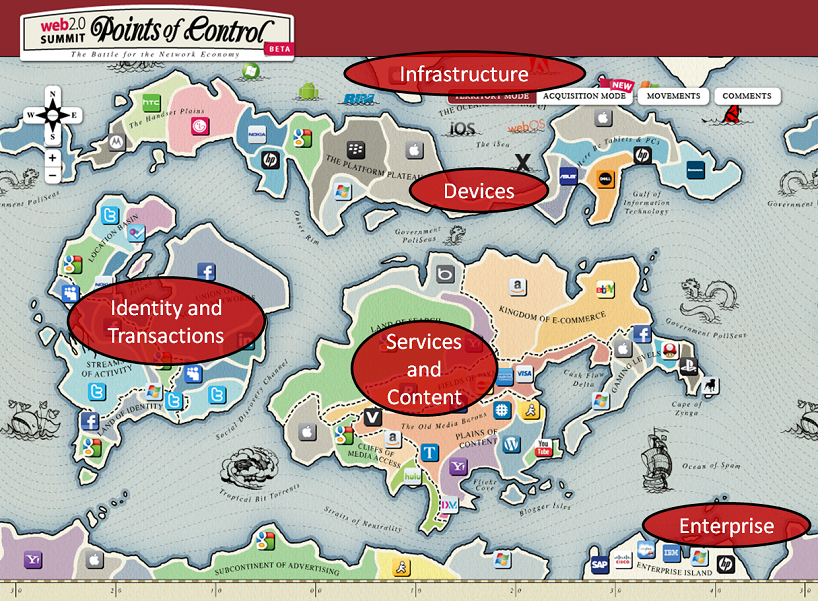
Later this month, the Web 2.0 Summit comes to San Francisco. In the pre-conference advertising, the co-chairs, John Batelle and well-known Web 2.0 advocate, Tim O'Reilly, have produced a map of Web 2.0 industry. The theme of the conference is 'Points of Control'.

So by the very title, the organisers believe that the initial period of rapid expansion of the consumer internet is drawing to a close. If true, the organisers believe that existing dominant players are shifting their policies from the the rush-everywhere, hasty land grab to retreat to their strategic power bases to pit themselves against each other in a market that is now maturing.

Admittedly, this Points of Control map and the introductory video (which is very illuminating) can be written off as pre-conference rabble-baiting, I disagree on several points:

Enterprise Participation has only just started
To date, Web 2.0 has been consumer driven. John and Tim rightly point out that big corporates have only just started to engage with the Web 2.0 concept and their audience. This is SO true - there is a huge potential here, which has only just begun: use of social software to interact with consumers over a wider of devices and technologies.

I for one predicted in 2002 that the consumer internet and the enterprise internet would together mutually drive adoption. In actuality, the consumer internet proved to be much more vibrant and exciting than the enterprise internet. Now, I believe, it is the turn of the enterprise.

Also, I believe that exciting services from enterprises will drive another growth phase in internet.

Viewpoint is US-centric
In terms of users, the internet is opening up to a vast pool of users who have been denied it to date: BRIC represent a user base to equal the existing user base. The services that they use will not be in the English language. Nor will they access internet services in a desktop manner: mobile (smart) phones, tablets, powerful netbooks.

Summary of the Map
Clearly, this maps was intended to controversial and the authors intended it to generate feedback. Here's my interpretation of the map (with my overlay):

(click for a larger image)


The map can be summarised in tiers:
  • Infrastructure: XaaS - 'X as a Service' where X is Platform, 
  • Devices:  these are the platforms that users access service
  • Services & Content: obvious I hope, but the line between services, devices and infrastructure will continue to blur. (The diagram needs isthmuses or bridges or low-lying marshy areas???
  • Identity & Transactions: Historical memory of users: their attributes, preferences, transactions, behaviour. Currently, this area is welded into Services. I believe that this will fragment into a separate user-centric cluster of identity services (with bridges and integration points everywhere)
  • Enterprises: these could be classed as Services, but this 'land mass' is so substantial and has so much potential that IS worth breaking this out as a separate territory.
Interestingly, no mention is made of Public / Government Services, which is another area with oodles of potential.

Update: Speaker Slides and Videos

03 November, 2010

State of The Blogosphere

Technorati CEO Richard Jalichandra gave his annual State of The Blogosphere presentation (click to view on Scribd) at the ad:tech conference.

The power of social media: Brutal, compelling evidence as to the power that the two giants of social media, Facebook and Twitter, have on website traffic. (Slide 20)


Why use Twitter
The The top five reasons for using mico-blogging ie Twitter (Slide 18):
  1. To promote my blog
  2. To bring interesting links to light
  3. To understand what people are buzzing about
  4. To keep up with news and events
  5. To interact with readers of my blog

21 October, 2010

Opera 11 is coming soon


Well, you would have thought that by v11 of a product, it would have become pretty insipid. The Opera browser remains at the very forefront of internet technology - it generates raw innovations that appear in other browsers in 18 months to 2 years' time.

And, in case you can't tell, I'm a huge Opera fan.


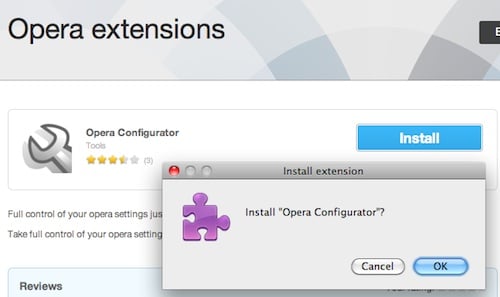
This review from The Reg, Inside Opera 11: extensions and benchmarks, is generous - extensions are one area that Opera has lagged. I only hope that enough developers engage with Opera's platform - I don't have a single Opera Widget installed, as they appear to be only fripperies. I hope extensions are different.

10 October, 2010

Detecting Contagious Outbreaks Through Social Networking

Fascinating (and compelling) methodology that has demonstrated to be valid - that you can detect the likelihood of contracting a contagious outbreak of an epidemic by monitoring the health of your friends.

Dr. James Fowler, Professor of Medical Genetics & Political Science at University of California (San Diego) proposed that people who have more friends will tend to become infected by contagions sooner than others with fewer friends. See Social Network Sensors for Early Detection of Contagious Outbreaks.

To test the method, Dr. Fowler and his team recently studied an H1N1 flu epidemic at Harvard College. Results showed that by simply monitoring the friends of randomly selected individuals, two weeks of advanced notice could have been given for this particular outbreak. Thus, monitoring friends is a good way to alert oneself at being at risk - better than checking your own symptoms.

30 September, 2010

Google's URL Shortener has QR Code functionality


Mentioned previously as a beta feature (Google adds QR Codes as part of URL Shortener), but now Google has officially launched its URL Shortener , Goo.gl with the QR Code generator. (See Techcrunch report.)

If you simply add “.qr” to the end of any goo.gl URL, it will create a QR code. Scanning this with any QR code reader will take you to the URL.

23 September, 2010

Top patent holders in Mobile Advertising

My previous post, Jockeying for position in Mobile Patent race, asked where Apple was in this race.

Alan Moore in in Mobile Patent Wars 2 answers my question:
  1. Yahoo
  2. Microsoft
  3. Google
  4. CVON Innovations
  5. Nokia
  6. NEC
  7. Qualcomm
  8. IBM
  9. AT&T
  10. Sony
  11. Motorola
  12. Sony Ericsson
  13. Hewitt Packard
  14. Hitachi
  15. Alcatel-Lucent
Of note, CVON is selling their portfolio on 11th November.

06 September, 2010

Jockeying for position in Mobile Patent race

Alan Moore writes on the Mobile Patent Wars. Here are some interesting snippets from this post:
  • The fact of the matter is that patents are all too often an after thought in many M&A process, RIM/Apple/Nokia/HTC have all been involved. Yet more multinationals are getting into patent wars, as we see today, using patents, to protect their competitive advantage.
  • More than US$1.7 billion was spent in 2008 on mobile advertising, and this number is expected to grow to more than US$12 billion by 2013.
  • More significantly, one in seven media minutes is spent with mobile already today. 
So those that own patents in the following areas would have their fingers on the levers of this burgeoning market. Alan reports that the following sectors would be valuable:
  • In-application advertising
  • Message tagging advertising
  • Mobile search advertising
  • Direct marketing to mobile devices
  • Social media and instant messaging
  • Pay per action in mobile devices
  • Advertising campaign optimization in mobile devices
Finally, CVON is selling the world's fourth largest mobile advertising patent portfolio  behind Yahoo!, Microsoft, and Google. It consists of more than 300 patents and patent applications across 58 patent families. (Side note: where's Apple in this race??)

So acquiring this little lot would be the equivalent of swallowing a jar full of steroids in the mobile patent wars for any of the existing competitors, I assume??

25 June, 2010

Agile Software Development - put in historical perspective

I went to the Cambridge Product Management Network last night on 'Product Management in the Agile World' from Roman Pichler, author of Agile Product Management with Scrum: Creating Products that Customers Love.

Agile in a historical perspective
Paul Walsh made a very insightful comment:

Agile (2000s) = Rapid Application Development (1980s) + User Experience (1990s)

RAD was all about prototyping, customer involvement and fast feedback. BUT those prototypes tended to be technology prototypes and didn't include what the customer actually received or experienced, so that they could provide decent feedback and steer the development effectively.

Paul and I nattered afterwards and both agreed that Agile wasn't best for v1 development, but much better for enhancement and product extensions.

On big, hairy feature enhancements
In fact, Agile means that you tend to avoid big, hairy feature enhancements because by their nature, they require lots of work which can't fit into a 6 week release cycle. So you tend to pick off the 'easy' incremental enhancements while the whole product slowly degrades whilst product management frets about 'biting the bullet'.

This problem is only solved by kicking out a research project that is independent of the development cycle. Agony and paralysis occurs when development needs SOME of the research project NOW and development starts cherry picking out of research. Yuk - a big management and technology sink hole, but sometimes inevitable.

Platforms
Also Agile was much harder in platform + products environment (ie products that were dependent on a platform on which other product relied upon) rather than a single product development track. I'm not saying it isn't possible, simply harder - particularly if the other products on which the platform relies have difficult development cycle times.

Thinking about it, for the same reason, products that require VAR /distribution & delivery partners mean that the feedback cycle is longer and more at arm's length than the development cycle demands. This means that there are lots of incremental releases that never make it into the market / customers' hands.

28 May, 2010

Opera's State of the Mobile Web Report

Some interesting stats from Opera's State of the Mobile Web Report from April 2010 (courtesy of Opera itself):
  • In April 2010, Opera Mini users generated over 398 million MB of data for operators worldwide (ie compressed data). Data in Opera Mini is compressed by up to 90%. If this data were uncompressed, Opera Mini users would have viewed over 3.7 petabytes of data in April.
iPhone Stats
  • Opera Mini for iPhone was downloaded more than one million times in its first day of availability on 14th April 2010.
  • In April 2010, there were more than 2.6 million unique users of Opera Mini on the iPhone (from April 13-30). (That's 17 days after launch!). 

27 April, 2010

Salesforce acquires Business Contact Directory Jigsaw For $142m

  +  

Salesforce.com has agreed to acquire Jigsaw which provides crowd-sourced contact information for business. The deal is worth approximately $142 million in cash, plus a performance-based earn out of up to 10% of the purchase price, according to Techcrunch.

I derided Jigsaw when it first launched in April 2004 (see my blog post), as it allows users to buy other people's contact information, without their permission.

The model has changed - but I still dislike the whole concept:
  • Users are no longer paid cash to upload contacts. Instead they receive points that can be used to download contact other people's contact information (ie not real currency, but a virtual one).
  • It is now positioned as contact information cleanup tool
  • Users can now see if their personal information has been uploaded, and there is a process to have it removed, at least temporarily.
  • Revenue was rumored to be around $30 million per year at the end of 2009.
  • 1.2 million users with 800 corporate customers.
  • Database of 21 million contacts at nearly 4 million companies.
  • The company had raised $18 million in venture capital to date.

07 April, 2010

Google adds QR Codes as part of URL Shortener


Not to be outdone by Facebook adding QR Codes (see recent post), Google has enabled QR Codes as part of the URL Shortener according to this Techcrunch report: Google Continues To Embrace QR Codes, Integrates Them Into Its URL Shortener.

So Google has a URL Shortener Goo.gl (yawn) which launched in December 2009 (Facebook And Google Get Into The Short URL Game). Today, Google added a very elegant feature: if you add “.qr” to the end of any shortened link, this will generate a QR code for it. For example, the link http://goo.gl/SJhz would become http://goo.gl/SJhz.qr.

Google are a clearly massive fan of QR Codes and this is an easy way to propagate them.

17 March, 2010

Facebook enables QR Codes

So, is it me or has interest in QR Codes just been punted into the fore? Clearly, when a service provider like Facebook adds this functionality (Facebook Kicks Off Implementation Of QR Codes), then it is going to have an impact in usability.

I don't know the legal situation with the use of QR codes in the US. Neomedia represents the IP owner with the most clout - justified or not. However, once again, they appear to be in trumpoil.

New home for this blog

Due to changes in Blogger's service, I am obliged to move this blog from its current location at www.stream121.com/go_for_it to a new home: http://blog.stream121.com

SO, please update your RSS feed to match this new address.

Thanks!

16 March, 2010

Facebook adds QR Codes

Clearly, when a service provider like Facebook adds this functionality to its service, then it is going to have an impact in usability. (See Facebook Kicks Off Implementation Of QR Codes)
According to the Techcrunch report then there are two  types of QR codes:
  1. a personal barcode which would (I assume) return a basic profile + link to your profile 
  2. “status QR barcode”. which would (I assume) return your current status when read.