HTML

stream121
Product Management :: Product Marketing


Showing posts with label Product Focus. Show all posts

10 March, 2021

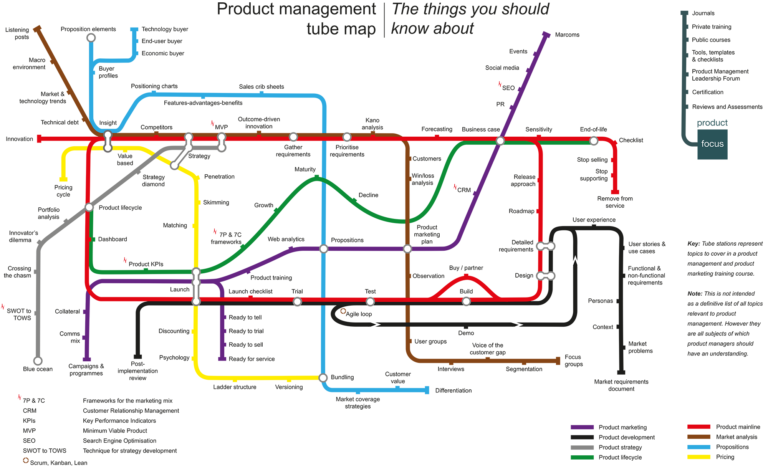
Product Management Tube Map

Product Focus have just published their Product Management Tube Map - SUPERB!


As well as being a lovely graphical interpretation of the role of Product Management, it shows the interconnected nature of product management and product marketing with many other business functions.

But Mind the Gap. In many companies, the focus is on Agile and Product Owners, and the strategic & leadership role of product management is missing

How true!

Possible extension to the infographic - 'Ticket to Ride'

The diagram made me think about the skills required to navigate the Tube Map - one's Ticket to Ride, as it were:
  • Business Savvy
  • Empathy
  • Communication skills: listening and clarity in written and vocal transmission
  • 'Spidey' sense of what's doing to happen next
  • Leadership (vision and direction) and Trust

12 June, 2020

Product Managers: Now, Next, Future

Steve Johnson, one of the respected voices in Product Management, cleans up some of the confusion about product roles and titles in Product Management. He admits that he (like me) is fan of  the “product management triad” - a product or portfolio team responsible for strategic planning, release planning, and launch planning. Here's the link to the particular post and full description of these roles

Title Scope Comment
Product Strategy Manager Future Evaluates and prioritizes future products and the portfolio
Product Owner1 Next Focuses on what’s next in terms of features and product options
Product Marketing Manager2 Now Focuses on products that are currently available

1 Steve prefers Product Planning Manager - yuk!

2 Steve prefers Product Growth Manager - yuk!

I do like the time box approach to the focus of each of these roles. Of course, this is simplified. It's not as if the Product Strategy Manager slurps espressos all day and pays no attention to the last quarter's sales figures or the Product Marketing Manager isn't constantly assessing the competition's capabilities and figuring out how to 'out-product' their offerings.


I would also recommend studying this Product Taxonomy from Product Focus (providers of product management training and resources - and one of the sponsors of the Cambridge Product Management Network).


Here's my take on 'Who owns what' which dovetails with Product Strategy vs Product Owner vs Product Marketing

Portfolio - owned by Product Strategy Manager

Responsible for managing the portfolio. He / She isn't the only decision maker. This is best managed by Product Investment Committee - this is a beast in its own right - but this has representation from Sales, Marketing, Product, Engineering, Research plus some financial modelling expertise.

The Strategy Manager often takes on the long-term management of the core platform, as moving the platform forward requires care and evaluation, because key decisions may negatively impact capability of the products that are built on top of the core platform. ie mods to the core platform are expensive and time-consuming to get right.


Propositions - owned by Product Marketing

This is the realm of product marketing. Product Strategy may be involved if there is cross-subsidisation of prices between products (or product lines) and platforms.

This area gets super complicated when propositions vary between countries / region of the world. Different countries may provide functionality for free (or charge for free functionality!) for a whole variety of valid reasons (local commercial agreements, tax or legal reasons, history & politics, how core product development costs are charged to territories). This is matter is worthy of another blog post or even a book!


Products - owned by Product Owners

When considered in a portfolio, this is the domain of product owners or, if the product is significant enough, a manager in their own right.
14 November, 2019

Continual, but elusive nature of Product Management


An article from Product Focus, entitled Product Management and the Impostor Syndrome made me realise the ongoing learning journey that product management provides and requires in order to master the art.

Their definition of impostor syndrome is
those affected cannot internalize their success and attribute it to external circumstances (“I’m just lucky”). They see praise as an overestimation of their abilities (“Oh, everyone could have done that”). On the other hand, failures, difficulties and slow progress are attributed mainly to their inadequacy (“I just can’t do it – others would”).
As one goes further on one's product management journey, one's skills increase - more and more scenarios have been tackled, more scars, more learning. Soon enough, what once was an eyeball-rolling challenge has become "Yeah, I'm sure I can pull that one out of the bag again".

Yes, Product Management is a diverse role - there is always more to learn - which it is continuously challenging and why I love the role..

This attitude of willingness to learn is good and important, but at the same time, we are often working at the limits (and beyond) of what we know. We are, therefore, not only exposed to inadequacies more frequently but, by pushing into areas where we’re not the expert, we also actively make ourselves more aware of them.
Product managers must retain their curiosity and embrace the aspiration of ‘lifelong learning.’ I believe impostor syndrome is just one side effect of our path to becoming better product managers.

24 November, 2016

What a product manager does on the first day, week, month, quarter

In conjunction with Product Focus, here's an infographic outlining what a new Product Manager should do in their first 90 days.

Download the PDF from Product Focus' website.

The raw task list was created as a result of meeting of the Cambridge Product Management Network. Then together, I and Ian Lunn from Product Focus converted the task list into an useful infographic for every product manager starting their new role.