HTML

stream121
Product Management :: Product Marketing


Showing posts with label product marketing. Show all posts

24 January, 2023

Product Management for Corporate Glue AND Lubricating Oil

Product Managers have a fascinating, all-encompassing role. They can be called many things, CEO of the product, Janitor, Super User. See Product Manager is a janitor basically.

All other business functions are well understood: 
  • Engineering develops the product
  • QA assures that the product 
  • Sales converts a product into justifiable business value for each customer
  • Marketing communicates the product proposition to a market of similar users / buyers
etc

But what do Product Managers do? 

  • Product managers are frequently the glue that keeps the rest of the business functions inside a technology organisation stuck together. They fill in the cracks in between all these business functions.
  • And they are the corporate 'oil' that lubricates other business functions within the company, making each function more efficient and in better harmony with each other.

Example
The next version of the product is coming. It's in Engineering. Product Management has defined the requirements of the product and during the build cycle, it assists with dilemmas and issue resolution.

QA is shaping up to receive the product, but this new version is more sophisticated than the previous version. The QA team need to understand the common use cases / user flows in order to write system / regression tests. They rely on Product Management for guidance.

Marketing is familiar with existing positioning, but this latest release opens up new markets and positioning. They rely on Product Management for guidance: what are the USPs? what are the best use cases? how should it be positioned and to whom? 

Sales may not be able to help for lots of reasons - they want to sell the existing products, not ones that aren't on the price list yet. The rest of the company is dependent on the Sales team selling the existing product in suitable volumes in order to pay the salary bill each month - you really want them sticking to the knitting and selling what's in the warehouse now, not yet-to-be-proven products still on the production line.

Additionally, they have had limited exposure to it: feature and functions aren't well understood yet, positioning isn't developed, use cases and case studies are embryonic at best

Account Management and Support want to know what's different about the new product and how can it be positioned to existing customers and how can they benefit most from it. Is it as good as the existing product? Can existing customers try it before they buy it etc? What the known limitations?

So, often it is the product manager / marketer that goes prospecting for beta customers and manages the beta programme(s) to their successful (hopefully!) conclusions. See the The challenge of beta programmes and Product Launch vs Release vs General Availability vs Deployment.

As a result, it is Product Management who is at the heart of technology product company, acting as its glue and the oil - and that's not contradictory!


09 January, 2023

ChatGPT for product management

With the release of OpenAI’s ChatGPT at the very end of November last year, there has been an explosion of enthusiasm. Here’s their trajectory to a million users!


(Thanks to Azeem Azhar of Exponential View)

Initially, the response was ‘Look at this cool poem that ChatGPT wrote.’ Thankfully more considered use cases are now developing.

So here are my thoughts on how ChatGPT can help Product Managers:
Broad Use Cases Use Cases for Product Management
Summarisation of a long body of text Summarising large amount of texts for requirements analysis
chatGPT is surprisingly competent at summarising text eg for condensing a whole list of free-form product requests from customers into a couple of pithy themes.
And the inverse, extrapolation of short body of text. Writing product descriptions for product marketing.
a. Reinterpreting features to benefits
b. Rewriting product marketing copy for particular audiences
Variation of an existing body of text Wearing your product marketing hat, you have written some descriptive words, but they need some help or the body of text needs to be shorter to fit into a text box on the website or on your PowerPoint.
Initial research into a topic or industry As Product Managers, we spend a lot of time trying to make sense of a market / customer / technology / product / service. I can see myself using chatGPT as a great start to understanding the four walls of a market.

Market research: what do I need to know about XYZ? What’s new and important in the XYZ sector? Who has the competitive advantage and why in XYZ sector?

It’s great a high-level summaries, but not good enough for the details that matter.


As always the devil is in the details, but at least it gives the Product Management some boundaries and some structure to start with. And you would never submit the output from ChatGPT as your completed, best thoughts, BUT it does provide a start and save on that first half hour / blank canvas problem / writer's block when you’re wondering where to start from.

ChatGPT for managers

One great advantage is that it can create consistency when you have review or compare work from multiple teams. By getting your teams to start with ChatGPT's output, then at least all the teams have started from the same point with their use case (not using a template).

What it won't do effectively?

Some have claimed that it could be used to write product requirements. Nope – well, not to a meaningful level and certainly not good enough to give to a developer.

Cute Use Cases

Side Notes on OpenAI
  • Who are their investors - it's always useful to know where the money flows. 
  • Y Combinator
  • Peter Thiel (founder of Paypal)
  • Reid Hoffman Foundation (founder of LinkedIn)
  • Khosla Ventures 
  • Elon Musk did invest, but has now sold off his stake
  • Microsoft Ventures ($1bn investment in 2019 + MS has built a supercomputer in Azure to support OpenAI ML research)

OpenAI have more complex corporate structure than most: there is for-profit corporation OpenAI LP and its parent company, the non-profit OpenAI Inc. AND in 2019, OpenAI transitioned from non-profit to "capped" for-profit, with profit cap set to 100X on any investment. (Source: Wikipedia)

10 March, 2021

Product Management Tube Map

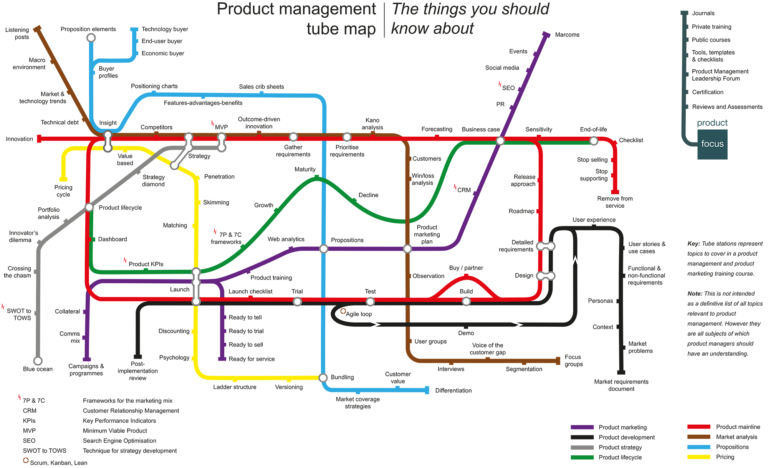
Product Focus have just published their Product Management Tube Map - SUPERB!


As well as being a lovely graphical interpretation of the role of Product Management, it shows the interconnected nature of product management and product marketing with many other business functions.

But Mind the Gap. In many companies, the focus is on Agile and Product Owners, and the strategic & leadership role of product management is missing

How true!

Possible extension to the infographic - 'Ticket to Ride'

The diagram made me think about the skills required to navigate the Tube Map - one's Ticket to Ride, as it were:
  • Business Savvy
  • Empathy
  • Communication skills: listening and clarity in written and vocal transmission
  • 'Spidey' sense of what's doing to happen next
  • Leadership (vision and direction) and Trust

12 June, 2020

Product Managers: Now, Next, Future

Steve Johnson, one of the respected voices in Product Management, cleans up some of the confusion about product roles and titles in Product Management. He admits that he (like me) is fan of  the “product management triad” - a product or portfolio team responsible for strategic planning, release planning, and launch planning. Here's the link to the particular post and full description of these roles. 

Title Scope Comment
Product Strategy Manager Future Evaluates and prioritizes future products and the portfolio
Product Owner1 Next Focuses on what’s next in terms of features and product options
Product Marketing Manager2 Now Focuses on products that are currently available

1 Steve prefers Product Planning Manager - yuk!

2 Steve prefers Product Growth Manager - yuk!

I do like the time box approach to the focus of each of these roles. Of course, this is simplified. It's not as if the Product Strategy Manager slurps espressos all day and pays no attention to the last quarter's sales figures or the Product Marketing Manager isn't constantly assessing the competition's capabilities and figuring out how to 'out-product' their offerings.


I would also recommend studying this Product Taxonomy from Product Focus (providers of product management training and resources - and one of the sponsors of the Cambridge Product Management Network).


Here's my take on 'Who owns what' which dovetails with Product Strategy vs Product Owner vs Product Marketing

Portfolio - owned by Product Strategy Manager

Responsible for managing the portfolio. He / She isn't the only decision maker. This is best managed by Product Investment Committee - this is a beast in its own right - but this has representation from Sales, Marketing, Product, Engineering, Research plus some financial modelling expertise.

The Strategy Manager often takes on the long-term management of the core platform, as moving the platform forward requires care and evaluation, because key decisions may negatively impact capability of the products that are built on top of the core platform. ie mods to the core platform are expensive and time-consuming to get right.


Propositions - owned by Product Marketing

This is the realm of product marketing. Product Strategy may be involved if there is cross-subsidisation of prices between products (or product lines) and platforms.

This area gets super complicated when propositions vary between countries / region of the world. Different countries may provide functionality for free (or charge for free functionality!) for a whole variety of valid reasons (local commercial agreements, tax or legal reasons, history & politics, how core product development costs are charged to territories). This is matter is worthy of another blog post or even a book!


Products - owned by Product Owners

When considered in a portfolio, this is the domain of product owners or, if the product is significant enough, a manager in their own right.

11 May, 2020

The challenge of beta programmes


In a previous post, I looked at the Product Management & Product Marketing model that Redgate Software (a local Cambridge-based company) uses. In it, I identified a component, that didn't appear to be addressed: beta programmes. 
 
A quick diversion into pronunciation
  • In the UK, it is pronounced 'Bee-ta'.
  • In the US, it is pronounced 'Bay-ta'
It's a pronunciation that I found far, far difficult to surmount when I moved to the US and when I moved back. 'Tom-mart-to' and 'Tom-may-to' was easy!

What is the purpose of a beta programme?

The build team (Engineering, Testing, Product Management, Implementation, Technical Support) want the beta programme to technically validate the latest functionality - that it works outside the lab, in real customers hands and that bugs are flushed out and those bugs are validated in subsequent releases. The end goal of a solid product should not be compromised by time constraints.
  • Marketing and Product Marketing want a case study and a quote for the press release - as soon as possible please.
  • Sales, Sales Engineering, the CFO wants a big name brand to do reference case study that ignites the sales pipeline - ASAP as well.
Hmm, plenty of different objectives!


Why should a customer participate in a beta programme?

I'm sure that we have all participated in these CBT (Customer-Based Testing) programmes at some point: buggy software whereby the customer does the testing - seemingly to the shocked surprise of the vendor. This can be immensely damaging to the beta programme, the provider’s brand, the relationship between participant and the provider.

And, for the customer, it's a darned good reason not to participate in a beta programme: too much effort for no advantage (or indeed negative advantage).

For this reason, providers need to ensure that, during the beta, they have the Engineering bandwidth to rapidly fix issues that are identified. This, of course, is difficult to estimate exactly how much resource is required, but essential that this remains top priority. Unfortunately, Engineering’s core capability of building beautiful, well thought-out functionality does not match the issue + investigation + quick response cycle of beta programmes – expertise that is embodied in Support or Professional Services.

Valid reasons for customers to participate in a beta programme are:
  • Access to latest version - see later for my experience with CDK Global
  • High-profile within the vendor's organisation: ie access to Technical resources or insight into the vendor's strategic intentions.
  • Cost-reduction in fees, perhaps for a limited period


Which business functions should participate in Beta Programmes?

There are many good and bad reasons why different parts of the organisation should participate in beta programmes.


Customers
Err, yeah, of course, but some customers have a different propensity towards beta programs.

Customer whales (ie big ticket customers) that that are currently in pre-sales should definitely not be part of a beta. It may destroy the sale altogether: experience with buggy software may leave a nasty impression in the mouth - even if it is exactly the functionality that they are begging for.

Getting a quote out of a whale's marketing department may take months, if at all.

Beta software is usually provided at a discount - possibly a significant discount - a discount which may never be recovered on full release and therefore full price - and too expensive a margin to surrender.


Existing customers are great for betas - they understand what the previous product does, users and the business buyer have a positive relationship with the beta provider. Technically and financially, the provider has been validated and approved. This certainly makes it easy to draw up a shortlist.

However, there may be enough 'baggage' in the account that existing customers may derail the beta at the outset. They may demand so-called 'fixes' (missing pieces of functionality that they perceive in the existing product) or their environment / use may not match the requirements of the beta functionality. They will want compensation for their participation - and this compensation may be more valuable for them then the business benefits of the beta software.

Some of the best beta programmes I have participated in have been with new business divisions of existing customers. Commercially an existing contract is easy to extend. The vendor sees new business and the customer has the assurance of existing proof elsewhere in their organisation.


New Customers
New, NEW customers can also be really good. They genuinely behave like new customers.
They generally have more operational flexibility - they haven't honed their own processes to your product yet - and recognise that they need to create new processes.

Existing customers may say, "Yes, we'll be on your beta - as long as the product is "better" and nothing changes." Well, if the beta product aims to cannibalise the existing product, then the beta product will be "different" - better in many respects, but different in others. These differences may be negative enough to existing customers that they outweigh the new advantages.

The issue may be become more apparent if the existing customer is now off-centre from the target market with the new product. Existing customers may feel that they are being shoved to one side by the relentless progress of the vendor - and this may give the existing customer on the beta programme a sour taste in the mouth.

Another advantage of new customers is that the beta programme doesn't have to tiptoe around Account Management or Sales and get their buy-in.


Testing
Testing needs to valid the software on its way out and also to validate any issue as reported. For this reason, it is often essential that Testing has access to an environment that has beta code on it - let's call it pre-production - they are interested in isolating the real-world issues in a lab environment. Messing around with the production server is not to be recommended as it may create serious degradation to the service.


Engineering
Well, yes, they created the software and they are responsible for delivering it and fixing it. They are critically interested in technical validation in real-world environmental.


Account Management
If an existing customer is involved, the participation of Account Management (or Sales or Professional Services or whatever function manages existing relationships) is undoubtedly required, particularly at the start and end of the beta programme.

This function is compensated with incremental revenue - quite rightly, they don't want to jeopardise their account with the unknown. So, account management need reassurance that their customers' participation in the beta will help their account.

If the beta programme runs in parallel with existing product, then Account Management and Customer Support continue to support the existing in-life product. If the beta programme cannibalises the existing product, then the beta programme manages and supports the customer.


Customer Support
This function is generally wary of beta programmes, as it is often increases the amount of first-line call handling that they are required to do.


Implementation / Professional Services Team
The participation of ProServe is dependent on the amount of customisation required for the beta customers. Development would like 'vanilla' customers with the least customisation. However, this is dependent on the interest of the existing customer base in the beta programme and, with gritted teeth, the beta programme may be obliged to accept a highly customised account into the beta.

The great hope of vendors is that the new version fixes lots of issues in existing accounts - helping Account Management / Sales (unlocking new revenue), Professional Services (less implementation grief) and Customer Support (fewer issues and better relationship). And yes, it should leapfrog the competition and trample all others in the marketplace.


Special Cases - Saturated Markets
Newly all of my product experience has been in small scale-ups. However, I did have one fascinating experience working for CDK Global (see case study). As the Release Director, I was also involved with the Beta Programme - admittedly at arm's length.

CDK Global's product was the first major release in 12 years. It is worth mentioning because CDK Global dominated their market with 60%+ Total Ownership. Their customers (car dealers) operated in a highly competitive market and any new advantage could significantly tip the market. So, getting on CDK Global's beta programme could be a game changer in the short- and mid-term. When a slot on the beta programme was offered to a shortlist of existing customers, each place was eagerly snapped up.

Conclusion

Beta Programmes are extremely important to software creation teams, but managing these diverse expectations can be equally difficult - particularly when the product launch (with all those expectations!) is dependent on it.

11 December, 2019

Product Management and Product Marketing - a perfect union in B2B


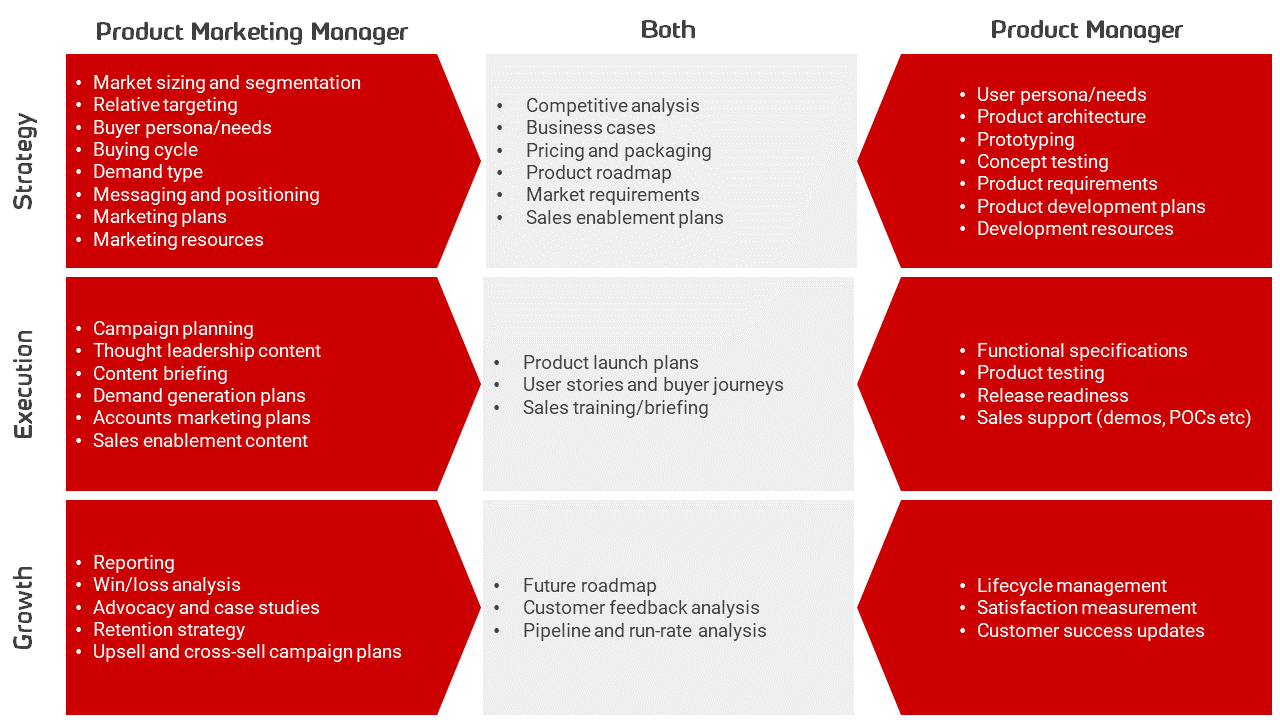
Redgate Software explain how they define Product Managers and Product Marketing for B2B software - and how, together, they make a perfect union to bring products to market and how those products are consumed.


Their model (above) is based on the SiriusDecisions Product Marketing and Management Model which is reproduced below for ease of consumption as it is hidden behind a (free) registration wall (too much of an impediment for its value, IMHO).


Redgate's description is an improvement (much clearer and tighter in scope) where as SiriusDecisions diagram is more encompassing by slotting product in between marketing and sales.

Redgate's version shows the division of labour and where they work together.

Beta Programme Management

The only thing I see missing from Redgate's model is a beta programme management - which is referenced in SeriusDecisions model.

In my experience, the beta programme can be managed by either party, but best led by Product Marketing initially, who are closer to the customer. However, the lead may change in a small beta programmes, under three circumstances that I can think of:

  • The beta programme is very technical in terms of functionality and requires of Engineering's expertise to implement or generate significant value OR
  • The latest release uses novel technology which is 'sensitive' (shall we say!) or both the rest of the organisation and the customer don't understand OR
  • The beta has significantly more technical issues than anticipated and effectively Engineering has to jump in and effectively resolve and effectively they run the show.


08 October, 2019

Career Paths into Product Management and Product Marketing

Last week, at the joint meeting of the Cambridge Product Management Network and Cambridge Network, I shared my observations and thoughts about common (and not so common) routes that Product Managers & Product Marketers have taken to get to their current position. Céline Sharpe from FIS (formerly WorldPay) shared her practical experience.

To view the slides, please go to Career paths into product management and product marketing on SlideShare

In summary, there are three core skills that product managers / marketers need have their arms around:
  • Proposition Development (eg Sales and Marketing)
  • Technical Construction (ie Engineering)
  • Value Realisation / Utility (eg User Experience, Implementation, Customer Support)


Given that technology innovation dominates the software industry then this is obvious. (Product Managers in the Food industry are likely to have Food Tech credentials, right??)

But there is a whole lot of other skills requires - and these are skills that can't be taught, but have to be learnt on the job:
  • Human 'Savvy' (ie awareness or sensibility)
    • Communication
    • Trust
  • Corporate 'Savvy'
    • Leadership
    • Project and Process Management
    • Translation

See SlideShare for more details.

24 September, 2017

SCOTSMAN for sales qualification


My previous blog post about communicating the commercial imperative of products was originally prompted by how frequently I, as a Product Manager, have discussed sales qualification of a prospect with respect to product differentiation and competition.

Frequently I had shared my insight with the sales teams:
  • "If customers says their problem is this, then this implies that they have solved this, this and this problem with  an alternative solution. As a result, they aren't a good prospect unless they have this characteristic."
  • "If a customer is asking about this feature, then that implies that they are currently used competitor X's product, as we know that this is their weakness. It would be best to differentiate our product by talking about this business problem."
  • "Competitor Y is particularly strong in that market, that prospect looks tough to bring over the line."
This often leads to a conversation about sales qualification in general. Here's a mnemonic called SCOTSMAN from salesplusprofit.com:

Sharing the commercial imperative of our products

I find that as a Product Manager or a Product Marketing Manager, we spend a lot of time communicating the value of our proposition's features, differentiating capabilities, value and how one's solution moves our customer's business forward to our sales and customer service teams.

But this message needs to be widely understood across the company.

Scenarios that I have frequently encountered:

  • Software Engineering develops features because they are 'cool' or based on the CEO saying, 'Wouldn't it be great if ....'
  • Software Engineering spends ages crafting out a solution to a long-tail problem where an 80/20 approach would be much more valuable
  • Testing validates the product feature based the product specification from Engineering (see previous point), not based on how the product would be used in an operational environment. 
    • As a tester in Dallas, Texas, I recall spending days testing a product feature only to be told that this particular narrow shard of functionality gets used about 5 times a year and only as a tool of last resort and only by highly experienced users who didn't need all the defensive protection from poor data entry or illogical data flows that had been tirelessly testing.
  • Research teams working on the functionally interesting problem and NOT on the biggest risk to the overall commercial success of the suggestion - which is frequently customer adoption in a competitive market. Poor research (or usually no research) is a HUGE waste of Development's team - a topic worthy of another blog post.
So whenever I see a specification or a proposition, I do my best to make sure it is crystal clear to the reader (whoever the intended audience is) how the proposed functionality will make our customers more money or save money or make our solution more compelling.

20 June, 2016

Where should a product manager spend their time

Excellent insight from an expert product manager, Gerrit Vermeire who is Director of Product Management at Barco.

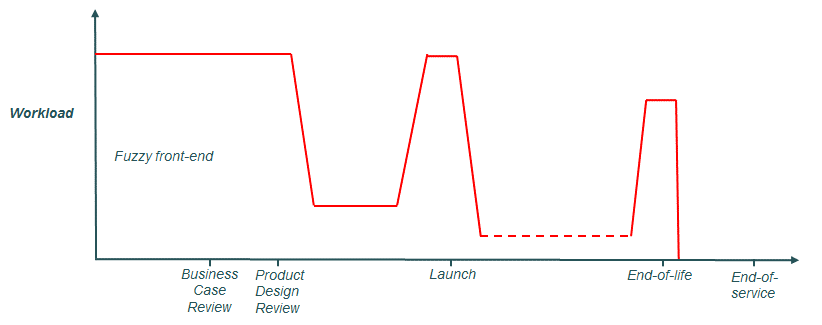
“I want to absolutely avoid product managers acting as an expert helpdesk i.e. doing things other people or proper documentation can handle. They should focus on the things nobody else will do if they don’t – such as defining the overall mid and long term strategy, creating the big picture, understanding the market problems and translating them into solutions and products on our roadmap. I want to drive the bulk of my product managers’ workload into the ‘fuzzy front-end’ – as shown in the picture. These are the more strategic activities of generating ideas, understanding what customers want, finding out what can be built and what could be commercially successful.”
Also Gerrit comments on managing a portfolio with multiple product managers

“If I make product managers fully responsible for a too limited set of products in the portfolio there is a danger they don’t see the big picture. Similarly if we split things by current and next generation or pre and post launch, we don’t get continuity through the whole life-cycle and risk missing a lot of key information.”
“What does work well is to off-load some product management activities to a separate product marketing team. They know their vertical markets well and drive the sales enablement activities during product launch. They have the insight to know which customers are best to talk to and can focus on managing the relationship. My product managers can turn up to customer meetings with new product ideas and get great customer feedback.”

Do read the rest of the article on ProductFocus website.


25 May, 2016

The value of an external Product Management Consultant

Many companies recognise that they have a requirement for Product Manager. However, for some companies, they have muddled along without one but know privately that it remains an Achilles heel.

This may be passable on a day-to-day basis, but to build a long term roadmap or to make a step it is sorely lacking some expertise.

There is a perception trap here: some organisations don't really grasp what the product manager does and so underestimate the scope of the role, so can't justify a full time role.

Recently, I have been talking to organisations about part-time / interim Product Management – and particularly the value that an external product management consultant brings.

What an external consultant does NOT bring

  • Intimate knowledge of the technology
  • Intimate knowledge of the product and service
  • Intimate knowledge of the market
These factors may, to some, to be crippling reasons as to why an interim product manager or a short term consultant may not be able to provide enough value. But this is incorrect – these very reasons provide tremendous value.

Advantages of an independent consultant

  • Objectivity An external consultant can be dispassionate about origin of products, their history, the processes or the people behind it. This person can look objectively at the products / product portfolio / product processes at that point in time and provide an unbiased perspective without the burden of historical baggage.
  • Independence An external consultant is equally unknown to all the organisation - therefore that person has no 'pet' interests, favouritism or bias.
  • Ignorance of the Product and the Market An external consultant is unlikely to know the intricacies of the the product or the market - and cannot hope to (in comparison to the expertise of the existing staff). Therefore, the important (but sometimes overlooked) statements of product differentiation, market characteristics, competitive analysis and product-market fit have to be clearly articulated. 
  • Better Decision Frameworks The external consultant should bring toolkit of analytical and decision frameworks that map analysis and research, leading to transparent and justifiable decisions. In my experience, once complete, it is rapidly realised that the product positioning and collateral is missing half of the value proposition.
  • Best Practice from other industries / sectors An external consultant should bring a wealth of experience learnt elsewhere on alternative business / revenue models, partner relations, go-to-market techniques, pricing strategies etc.


How to get the best out of a Product Management consultant

Interim Product Management consultants do need to be contracted / engaged properly in order to define boundaries for both side. There are several modes:
  • Time based (ie per diem)
  • Capped (ie we'd like up to x hours / days of your time)
  • Please complete this task by this date (eg hit a release date)
  • Objective based
  • Task based


Projects that suit an external Product Management consultant

External product management consultants are best at the following tasks:

Product Management

  • Competitive Analysis
  • Product Portfolio Analysis 
    • see this excellent session on Portfolio Management given by Richard Jones to the Cambridge Product Management Network
  • Product Testing & Review: 
    • External product testing, user experience, review of product literature (eg help documentation, training materials etc) and positioning

Product – Market fit

  • Product Roadmapping – see my presentation on Seven Rules of Product Roadmaps
  • Pricing Analysis
  • Release Management – a dispassionate expert to steer a product towards release, during a stressful and critical period. See case study on CDK Global for my role as Release Manager.

Product Marketing

These types of tasks usually become part of the second phase of a product management project:
  • Sales and Marketing literature review eg collaterals, external website, sales training, sales tools

Development Processes and Tools review

  • Again, these is often a phase two of a review, because the existing processes and tools have supported the existing status quo which has been identified as being unsatisfactory.
  • These endeavours are heavily operational and become difficult to generalise, but often these projects revolve around information / data collection and analysis to support decision making or information sharing – particularly to the sales and operational teams.


“Hold-the-Fort” Interim Product Management

Many companies leave the product manager role vacant for ages whilst they recruit the perfect candidate. Again, indecision / lack of consensus / strategic flip-flop may cause no end of pain.


‘Hoping’ that you’ll muddle through with your existing processes is well.... muddling. Does the investment in your development deserve a muddled product management approach?

The cost of not using a Interim Product Manager

If the organisation has decided you need a Product Manager then it is already 4 months too late. Any recruit spends 4 months playing catch-up with all the Product Management debt, so the company is waiting months and months before the Product Management function is actually leading the business forward.

When the permanent recruit comes on board, he or she is immediately deluged with a series of crises or burning issues. Their head immediately dives into the here and now, fighting fires and making snap decisions without a good understanding of context or history. This is an unpleasant start and most probably not what the new recruit was promised at interview.

With 4 months of no product management, each division of the business has already set off on its own journey of product management decision-making (ie they make decisions that are optimized to their own agendas, not those of the market), which makes steering the troops back on course towards a transparent set of objectives VERY difficult….. if not too difficult to contemplate.


Advantages of Hiring an Interim Product Manager

  • Product Management won't judder to a halt. Maintaining the discipline of Product Management will continue on and it won't cave in leaving the organisation to the ravages of a free-for-all.
  • New and refreshing thought process
  • Like all consultants, because they don't have the vested interest in the short term, they can look objectively at the long term.
  • The Bridging Product Manager can accelerate the onboarding process for new recruit. The new hire won’t be overwhelmed by a crisis situation and / or an overflowing issues list and / or a host of people grinding themselves against each other.

See Also

See this article from the 280 Group: Don’t Let Your Product Fail While You’re Recruiting for a Product Manager.


For assistance with your Product Management 

Please contact me.