HTML

stream121
Product Management :: Product Marketing


20 June, 2016

Where should a product manager spend their time

Excellent insight from an expert product manager, Gerrit Vermeire who is Director of Product Management at Barco.

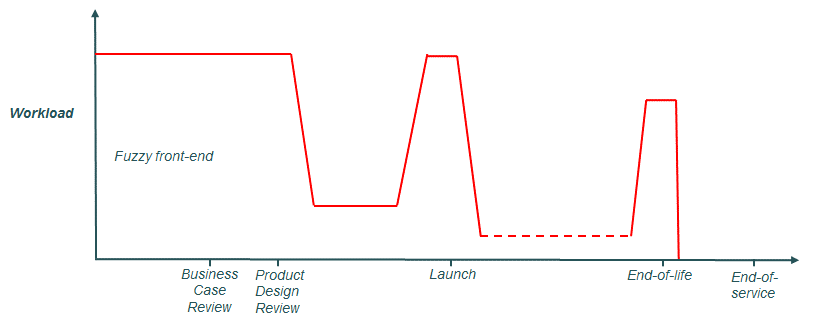
“I want to absolutely avoid product managers acting as an expert helpdesk i.e. doing things other people or proper documentation can handle. They should focus on the things nobody else will do if they don’t – such as defining the overall mid and long term strategy, creating the big picture, understanding the market problems and translating them into solutions and products on our roadmap. I want to drive the bulk of my product managers’ workload into the ‘fuzzy front-end’ – as shown in the picture. These are the more strategic activities of generating ideas, understanding what customers want, finding out what can be built and what could be commercially successful.”
Also Gerrit comments on managing a portfolio with multiple product managers

“If I make product managers fully responsible for a too limited set of products in the portfolio there is a danger they don’t see the big picture. Similarly if we split things by current and next generation or pre and post launch, we don’t get continuity through the whole life-cycle and risk missing a lot of key information.”
“What does work well is to off-load some product management activities to a separate product marketing team. They know their vertical markets well and drive the sales enablement activities during product launch. They have the insight to know which customers are best to talk to and can focus on managing the relationship. My product managers can turn up to customer meetings with new product ideas and get great customer feedback.”

Do read the rest of the article on ProductFocus website.


25 May, 2016

The value of an external Product Management Consultant

Many companies recognise that they have a requirement for Product Manager. However, for some companies, they have muddled along without one but know privately that it remains an Achilles heel.

This may be passable on a day-to-day basis, but to build a long term roadmap or to make a step it is sorely lacking some expertise.

There is a perception trap here: some organisations don't really grasp what the product manager does and so underestimate the scope of the role, so can't justify a full time role.

Recently, I have been talking to organisations about part-time / interim Product Management – and particularly the value that an external product management consultant brings.

What an external consultant does NOT bring

  • Intimate knowledge of the technology
  • Intimate knowledge of the product and service
  • Intimate knowledge of the market
These factors may, to some, to be crippling reasons as to why an interim product manager or a short term consultant may not be able to provide enough value. But this is incorrect – these very reasons provide tremendous value.

Advantages of an independent consultant

  • Objectivity An external consultant can be dispassionate about origin of products, their history, the processes or the people behind it. This person can look objectively at the products / product portfolio / product processes at that point in time and provide an unbiased perspective without the burden of historical baggage.
  • Independence An external consultant is equally unknown to all the organisation - therefore that person has no 'pet' interests, favouritism or bias.
  • Ignorance of the Product and the Market An external consultant is unlikely to know the intricacies of the the product or the market - and cannot hope to (in comparison to the expertise of the existing staff). Therefore, the important (but sometimes overlooked) statements of product differentiation, market characteristics, competitive analysis and product-market fit have to be clearly articulated. 
  • Better Decision Frameworks The external consultant should bring toolkit of analytical and decision frameworks that map analysis and research, leading to transparent and justifiable decisions. In my experience, once complete, it is rapidly realised that the product positioning and collateral is missing half of the value proposition.
  • Best Practice from other industries / sectors An external consultant should bring a wealth of experience learnt elsewhere on alternative business / revenue models, partner relations, go-to-market techniques, pricing strategies etc.


How to get the best out of a Product Management consultant

Interim Product Management consultants do need to be contracted / engaged properly in order to define boundaries for both side. There are several modes:
  • Time based (ie per diem)
  • Capped (ie we'd like up to x hours / days of your time)
  • Please complete this task by this date (eg hit a release date)
  • Objective based
  • Task based


Projects that suit an external Product Management consultant

External product management consultants are best at the following tasks:

Product Management

  • Competitive Analysis
  • Product Portfolio Analysis 
    • see this excellent session on Portfolio Management given by Richard Jones to the Cambridge Product Management Network
  • Product Testing & Review: 
    • External product testing, user experience, review of product literature (eg help documentation, training materials etc) and positioning

Product – Market fit

  • Product Roadmapping – see my presentation on Seven Rules of Product Roadmaps
  • Pricing Analysis
  • Release Management – a dispassionate expert to steer a product towards release, during a stressful and critical period. See case study on CDK Global for my role as Release Manager.

Product Marketing

These types of tasks usually become part of the second phase of a product management project:
  • Sales and Marketing literature review eg collaterals, external website, sales training, sales tools

Development Processes and Tools review

  • Again, these is often a phase two of a review, because the existing processes and tools have supported the existing status quo which has been identified as being unsatisfactory.
  • These endeavours are heavily operational and become difficult to generalise, but often these projects revolve around information / data collection and analysis to support decision making or information sharing – particularly to the sales and operational teams.


“Hold-the-Fort” Interim Product Management

Many companies leave the product manager role vacant for ages whilst they recruit the perfect candidate. Again, indecision / lack of consensus / strategic flip-flop may cause no end of pain.


‘Hoping’ that you’ll muddle through with your existing processes is well.... muddling. Does the investment in your development deserve a muddled product management approach?

The cost of not using a Interim Product Manager

If the organisation has decided you need a Product Manager then it is already 4 months too late. Any recruit spends 4 months playing catch-up with all the Product Management debt, so the company is waiting months and months before the Product Management function is actually leading the business forward.

When the permanent recruit comes on board, he or she is immediately deluged with a series of crises or burning issues. Their head immediately dives into the here and now, fighting fires and making snap decisions without a good understanding of context or history. This is an unpleasant start and most probably not what the new recruit was promised at interview.

With 4 months of no product management, each division of the business has already set off on its own journey of product management decision-making (ie they make decisions that are optimized to their own agendas, not those of the market), which makes steering the troops back on course towards a transparent set of objectives VERY difficult….. if not too difficult to contemplate.


Advantages of Hiring an Interim Product Manager

  • Product Management won't judder to a halt. Maintaining the discipline of Product Management will continue on and it won't cave in leaving the organisation to the ravages of a free-for-all.
  • New and refreshing thought process
  • Like all consultants, because they don't have the vested interest in the short term, they can look objectively at the long term.
  • The Bridging Product Manager can accelerate the onboarding process for new recruit. The new hire won’t be overwhelmed by a crisis situation and / or an overflowing issues list and / or a host of people grinding themselves against each other.

See Also
See this article from the 280 Group: Don’t Let Your Product Fail While You’re Recruiting for a Product Manager.


For assistance with your Product Management 

Please contact me.

29 April, 2016

Characteristics of a superb Product Manager

Product Focus authored this excellent blog post on the ingredients of an excellent Product Manager. Here's their initial suggestions:

  1. Passion 
  2. Great at networking 
  3. Thinks big 
  4. Accountable 
  5. Able to focus 
  6. Delivers 
  7. Expert compromiser 
  8. Good communicator 


The post and the comments underneath are well worth a read.

The additional attributes that have been suggested that I like are:

  1. Understand and can explain their basic product economics / Commercial Nouse
  2. Can bring teams together - I think this is a complimentary skill to 2. Great at Networking
  3. Causality / Insightful
  4. Knows their market / customers
  5. Bounce-back-ability

This list is interesting to compare with Product Management interview questions from Ken Norton.

23 July, 2015

Microsoft Office, Messaging, Needs, Standardization and Interoperability

This is a cracking article about 'Tools for getting the job done' (hat tip to Clayton Christensen), standardization of processes, ubiquity and interoperability.

Also watch this stylized video about Productivity Future Vision from Microsoft.


It ends with this classic quote:
Old: all software expands until it includes messaging
New: all messaging expands until it includes software

26 June, 2015

How to connect back to your customers

If, like me, it takes a real dedicated effort to really understand customers' requirements and get quantitative and qualitative feedback (ie saying 'No' to lots of other things!), then this list of mechanisms from Product Focus is a good refresher, plus some new techniques that I wasn't aware of


  1. Roadmap reviews –  face to face interview with customers
  2. Focus groups – facilitated sessions to get in-depth insights about your product
  3. Implementation and operational reviews - in-depth discussions about how your product works
  4. Customer Surveys - invite your customers to give their views through online and product surveys 
  5. User groups and user conferences - bring customers together to talk and listen
  6. Observation – watch how customers behave    
  7. Product usage analysis - get information from your product on how it’s being used  
  8. Prototypes and Scrum product demos - let customers give feedback about your product as it’s being built
  9. Outcome Driven Innovation (ODI) - a structured questioning techniqueto understanding customer needs   
  10. Kano analysis – how to decide what’s important for your next release
  11. Conjoint analysis – using statistics to uncover customer preferences
  12. Innovation games – using games to uncover customer requirements   


01 April, 2015

NTT DoCoMo shuts down its 2G network

After 20 years of service, NTT DoCoMo shuts down its 2G network. It was Japan's digital phone services (i-mode was launched in 1999 on this network) that was initiator of mobile internet service. According to Eurotechnology Japan, the last 2G phone was shipped in December 2007.

09 September, 2014

Deadlines

I love deadlines. I like the whooshing sound they make as they fly by.


Douglas Adams, author of the Hitchhiker's Guide to the Galaxy
 
Applicable to product / project managers!


28 July, 2014

The seven nations where SIM cards outnumber people

Would you have guessed them?
Finland (at 125%!), Australia, Japan, Sweden, Denmark, Korea and the United States.

Technically, according to this Register article, these countries have more mobile data accounts than people.

And where is the UK on this chart? At 75%

06 May, 2014

Product Manager is a janitor basically

A great blog post. A Product Manager is a:
  1. CEO
  2. Coach
  3. Engineer
  4. Janitor
  5. Hammer
  6. Router
  7. Super User
  8. Inventor
  9. Ghost
  10. Your Product
Click on the link to find out why!

23 April, 2014

Global sales of 4G phones to double to 500 million


CCS Insight reports, in its Mobile Phone forecast - April 2014 (thanks to article in Mobile News article), sales of 4G phones are set to double this year and rise to 1.2 billion in 2018, accounting for over half of the 2.4 billion phones sold in that year.

It is anticipated that the key driver [for that adoption] will be the cost of 4G phones falling below €€100 in the second half of this year, with most operators removing any premium for using the services.

Globally, CCS Insight is predicting unit sales will grow from 1.95 billion in 2014 to 2.29 billion in 2018. Smartphone sales will make up 64 per cent of sales this year and 82 per cent in four years time.

From this, the proportion of 4G-enabled sales will almost double from 26 per cent to 51 per cent, with 56 per cent of phones sold in Western-Europe this year being 4G-enabled.

Across the board, the analyst also expects the average selling price (ASP) of mobiles to fall this year from $168 this year (£100) to $154 (£92) in 2018.

The forecast predicts that Android’s, which accounted for 79 per cent of the one billion smartphones sold last year, will see its dominance continue. Despite doubts over the commitment from manufacturers to Windows Phone, it said its ability to compete at lower price points and taking advantage of BlackBerry’s recent decline will enable it to benefit.

04 March, 2014

6.7 million UK adults have never gone online

Office for National Statistics reports that 87% of the adult British public now has some internet experience, resulting in a total of 44.3 million users. This still leaves 13% or 6.7 million without the benefit.

Clearly, there's an age skew: 36% of adults aged over 75 and 69% for those aged 65-74 had been online.
 
And there's another skew - geographic: London, for instance, has the highest proportion of internet users at a total of 90%. In comparison, Northern Ireland, despite having the best coverage of superfast broadband in the UK, has the lowest with just 79%.

01 February, 2014

Number of SMS Messages sent falls - a point of no return

Gone are the glory days of SMS messaging when usage was exploding at 30% a year. Two reports show that 2012 was the zenith of SMS and more grim figures are to follow.

A Deloitte study reports that 145 billion SMSs were sent in the UK in 2013, down a sliver from 138 billion (a drop of a mere 5%). Users are substituting SMS with instant messaging services like WhatsApp, Viber, Snapchat and Facebook to stay in touch.

There were 160 billion instant messages last year and this figure is predicted to nearly double to 300 billion by the end of 2014.

This has occurred because instant messages (note that the apps listed above support images, video and even audio - quite a concept when you think about it! - between users) sent over data are free and group texting is easier (remember my own start-up providing MiCircles, faithful readers?)

The operators have already responded - SMS are virtually given away - except for the odd entry level contract where SMS packages are unlimited.

At similar, woeful story comes from Strategy Analytics (Operator Revenue from SMS, MMS on The Decline): global SMS & MMS revenue fell by almost 4 percent last year to just below $104 Billion. By 2017, 20% reduction in revenue is projected, with regions with a high penetration of smart phones set to see the biggest drop off in revenue: revenue in America is estimated to fall by 38% and an 28% drop in Western Europe.

23 January, 2014

Broadband is the most important invention of the Naughties


Institution of Engineering and Technology (IET) surveyed 2,000 UK adults aged between 16 and 75 to name the best tech developments of the last decade. (Story from Engineering and Technology Magazine.)

Results: 53% said broadband, ahead of smartphones and satellite navigation. 1% each for on-demand TV and Android smartphone apps.

13 January, 2014

Trading our privacy for functionality

If consume a free product, then stop and think:

If you aren't paying for the product, then you are the product.

From an excellent ReadWrite article:
Lost in the furor over government spying on its citizens is an inconvenient truth: personal data is the new currency of the 21st century, and until we rein in our desire to spend it we can't really stop others' desires to spy on it.

But we are the ones happily selling ourselves for a few more gigabytes of storage, or a way to talk with friends. We used to pay for such things with money. Now we pay with our private details through our personal details.

The public has to ask itself a hard question: Do we care? Or are we happy to sell little pieces of our online selves in the name of ease and convenience?

09 January, 2014

Virgin Media records its highest ever broadband traffic on 5th Jan


In the UK, Sunday 5th January was the day before back-to-skool Monday after the traditional two week shutdown over Christmas.

SimplifyDigital reports:
At its peak, between the hours of 8pm and 9pm, 1.67Tb of data per second was flowing back and forth between Virgin Media and its customers, with a total of over 11.55 Petabytes being delivered over the 24 hour period.
One can only assume that consumers had finally worked out how to connect their new tablets (that they received on Christmas Day) to their wi-fi and were happily streaming a ton of TV to their new toy.

19 December, 2013

Watching TV Online

36% of UK internet users confirmed they watch online content every single week, much more than consumers in Germany, France, Spain and Italy. See Simplify Digital for more

02 December, 2013

Mobile Subscriptions to rise to 9.3 billion by 2019

According to latest  Ericsson Mobile Report, mobile subscriptions will rise to 9.3 billion by 2019.

Wow, I thought that's a lot. Then the report went on to say that total mobile subscriptions currently stands at 6.6 billion.

Look at the explosion in data usage:

Johan Wibergh, Executive Vice President and Head of Business Unit Networks, discusses the latest Mobility Report:


01 October, 2013

The rise of Google Chrome

This graph from the Economist (Daily Chart - Browse beaten) shows how many Internet Explorer users have migrated to Chrome.


According to another Economist article Chrome rules the web:
Chrome is now responsible for about 43% of all the web traffic generated by the world’s desktop computers. When Chrome was launched the dominant browser was Microsoft’s Internet Explorer (IE), with a 68% share—it is now down to just 25%.
The penetration of Android on mobile phones and now tablets will surely increase this dominance.

09 September, 2013

The use cases of 4G

In a previous blog post, I laid out the status of 4G mobile roll-out.

Everything Everywhere, the operator with the most advanced 4G deployment has released their 4G Mobile Living Index Report.

Clearly it is brochure bigging up 4G, but my inbuilt skepticism kicks in. Reading the report, there are some interesting snippets:
  • People are sharing videos and pictures over 4G, leading to network upload traffic overtaking download traffic at key events.

The key task that has been enhanced with 4G is video streaming (ie downloading). Reading emails, posting on social networks - network speed isn't a major differentiator for these tasks exactly - but network coverage is. However, if you have bought a whizzy 4G phone, then it will have a nice 5Mb / 8Mb / 12Mb camera. If you wish to upload a photo to Twitter (who immediately compress it to <500kb a="" another="" appear="" be="" it="" media="" nbsp="" or="" p="" process.="" site="" social="" tedious="" to="" will="">
What is really interesting is 4G usage for tablets:
Looking at 4G-capable tablets and smartphones, there is a marked difference in how the devices are being used. Broadly, smartphones match general web browsing usage patterns (see previous page of the PDF Report) and tablets reflect streaming.

It demonstrates how the smartphone on a 4G network is an integral part of daily life, with activity beginning relatively early in the morning and only tailing-off just before midnight. With 4G, the promise of the "always online" generation becomes a reality.

The bottom graph displays iPad usage. It peaks markedly in the evening, highlighting that not only do 4G users like to stream on their tablet devices, but that the tablet is less a feature of the normal working day for most people than the smartphone. There is a small peak around 4pm on the iPad graph that likely indicates children use it either upon return from school or when travelling home.

I conclude that tablets are a leisure device - particularly for junior members of the family. Dad is watching the football on the main TV and the children bounce in between games, messaging and watching a TV programme on their tablet.

Opera make a browser specifically for the iPad

I make no secret of the fact that I am a massive Opera fan. They have produced a browser just for tablets.


I applaud the decision - which recognises that a touch only interface impacts the User Interaction.

However, given the availability of hybrid devices (ie tablets that have keyboard docks) I'm not sure of the merits of this being a stand alone app - ie separate from standard Opera. Surely this would be best as a 'mode of use' option? It would be great if Opera sensed whether the user was in tablet mode or in laptop mode (ie with keyboard) and popped up an invitation to switch into an alternative user mode.

I would be most interested in feedback as to how Opera Tablet works.